
Growing lemon trees at home is a dream for many gardeners. Fresh lemons, fragrant blossoms, and lush green foliage make citrus trees a beautiful addition to any garden or balcony. But one challenge many gardeners face is getting cuttings to root successfully.
Rooting lemon cuttings can sometimes fail due to dryness, fungal infection, or weak natural hormones. That’s why many gardeners turn to chemical rooting powders.
But what if you could achieve the same rooting power naturally, cheaply, and safely?
Surprisingly, the answer lies in a common kitchen ingredient—potatoes.
Yes, potatoes contain natural compounds that stimulate root growth, prevent fungal infection, and keep cuttings moist. Gardeners around the world have quietly used this trick for decades, and today it’s gaining popularity again because it works amazingly well.
In this guide, I’ll share how I used potato power to grow lemon trees faster, why it works, and how you can replicate the method at home with a near-guaranteed success rate.
Why Potato Helps Lemon Cuttings Root Faster

Potatoes are rich in:
- Natural sugars
- Starches
- Moisture
- Auxins (root growth hormones)
- Antimicrobial compounds
These properties create a perfect rooting environment.
Auxins
Auxins stimulate root formation.
Potato tissues contain natural auxins similar to commercial rooting hormones.
Moisture
Potato flesh holds moisture gently, preventing the cutting from drying.
Antifungal properties
Potato’s natural compounds reduce fungal growth, which is a major cause of cutting failure.
Nutrients
Starch provides energy for developing roots.
Because of these qualities, a potato can act like a natural rooting capsule, encouraging roots to form quickly and strongly.
What You Need for “Potato-Powered” Lemon Propagation
You only need 4 things:
- A healthy lemon branch
- A fresh potato
- A sharp knife
- A pot with soil
Optional (but helpful):
- Aloe vera gel
- Cinnamon powder (anti-fungal)
- Plastic cover
That’s it—no chemical rooting powder required.
Step-by-Step Guide: Using Potato Power to Root Lemon Cuttings

Follow these steps carefully for the best results.
Step 1: Choose a Healthy Lemon Branch
Select a branch that is:
- Semi-hardwood
- Green with some firmness
- 6–8 inches long
- Free from pests
- Has 3–4 nodes
Avoid very soft, new growth or old woody stems.
Step 2: Cut the Stem Cleanly
Make a slanted cut just below a node.
Slanted cuts expose more surface area → faster rooting.
Remove leaves from the lower half.
Leave 1–2 leaves at the top.
Step 3: Prepare the Potato
Choose a fresh, firm potato.
Using a knife:
- Cut the potato in half
- Make a hole in the center
- The hole should fit the cutting snugly
- Depth: about 2–3 cm
This hole acts like a natural rooting chamber.
Step 4: Insert the Lemon Cutting into the Potato
Insert the base of the cutting into the hole.
Make sure:
- It fits tightly
- The cutting touches the moist potato tissue
- No part of the cutting is exposed
Step 5: Optional Natural Boosters
Before inserting into potato, you can dip the cutting in:
- Aloe vera gel → stimulates roots
- Honey → antibacterial
- Cinnamon → anti-fungal
These increase success rate even more.
Step 6: Plant the Potato + Cutting in Soil
Fill a pot with:
- Cocopeat
- Compost
- Sand
Mix: 40:40:20
Place the potato with cutting into the soil.
Cover the potato slightly with soil but don’t bury the cutting leaves.
Step 7: Water Lightly
Water gently so:
- Soil remains moist
- Potato stays moist
- But soil is not waterlogged
Overwatering kills the cutting.
Step 8: Create a Humidity Chamber
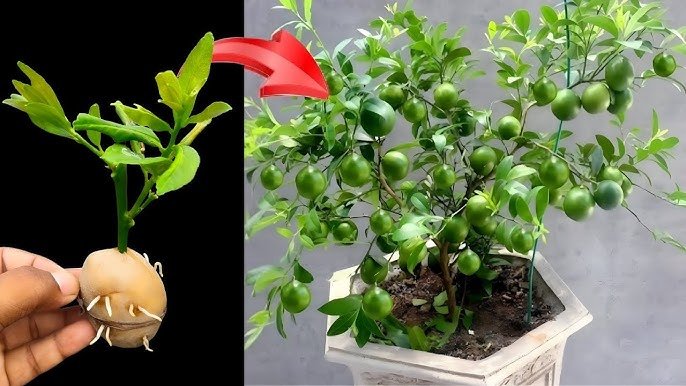
Cover the cutting with:
- A plastic bottle
- A transparent bag
- A small humidity dome
This traps moisture.
Step 9: Place in Indirect Sunlight
Avoid harsh sunlight.
Best location:
- Bright
- Wind-free
- Shade or morning sun
Rooting Time
With the potato method, lemon cuttings root in 3–4 weeks, sometimes even faster.
How to know roots have formed?
- New leaves appear
- The cutting feels firm
- The potato becomes slightly soft around the cutting
- You can gently pull—if it resists, roots are present
Step 10: Transplant the Rooted Cutting

When roots appear:
- Carefully remove soil
- Gently take out the potato
- Remove the potato pieces
- Keep the root ball intact
- Plant in a pot or ground
Use a mix:
- Garden soil
- Compost
- Cocopeat
- Sand
How Potato Power Helps Lemon Trees Grow Faster After Rooting
Once rooted, your lemon plant grows faster because:
Stronger root system
Roots formed inside the potato are thick and healthy.
Less transplant shock
Roots develop while still connected to the potato → gentle transition.
Natural hormones continue to stimulate growth
Auxins from potato remain around roots for several days.
Reduced fungal infection
Potato’s antimicrobial compounds protect young roots.
Care Tips After Transplanting
To grow a lemon tree quickly, follow these extra steps:
1. Provide Full Sunlight
Lemon trees need 6–8 hours of sunlight.
Sunlight boosts:
- Photosynthesis
- Growth
- Flowering
- Fruit production
2. Water Properly
Rules:
- Keep soil slightly moist
- Avoid waterlogging
- Water when topsoil dries
3. Feed With Organic Fertilizers
Every 30–45 days:
- Vermicompost
- Banana peel fertilizer
- Seaweed extract
- Cow dung compost
Apply lightly.
4. Prune for Strong Structure
Prune early branches to:
- Create a good shape
- Encourage new shoots
- Increase flowering
- Prevent weak stems
5. Protect from Pests Naturally
Common pests:
- Aphids
- Mealybugs
- Leaf miners
Use:
- Neem oil
- Soap water
- Turmeric spray
How Soon Will Your Potato-Propagated Lemon Tree Fruit?
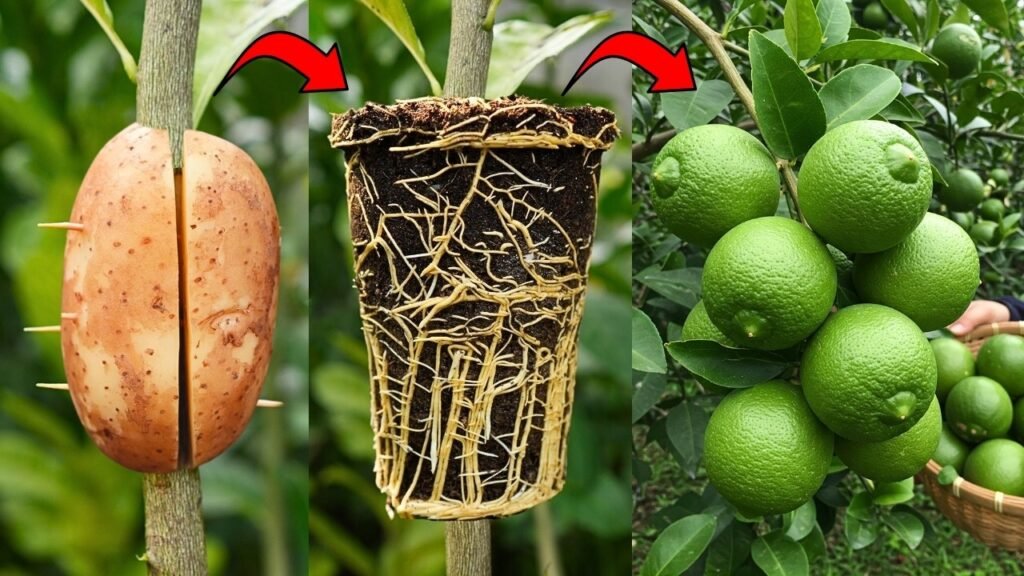
Because the cutting comes from a mature branch:
Fruit may appear in 1–2 years
Much earlier than seed-grown lemons
Fruits will be identical to the parent plant
Advantages of Using Potato Power
Natural & chemical-free
No expensive rooting hormones
Works even for beginners
Higher success rate
Stronger roots
Affordable
Safe for organic gardening
Many gardeners report 90% success using this method, especially in warm climates.
My Experience With Potato-Powered Lemon Propagation
When I first tried this method, I expected it to fail—after all, it sounded too simple.
But to my surprise:
- Roots appeared in 21 days
- Cuttings stayed fresh and moist
- No fungal rot
- Plants grew vigorously
- Transplants recovered instantly
Compared to regular cuttings, potato method cut failure rates dramatically.
Now it’s my go-to technique whenever I propagate citrus.
Final Thoughts: Potato Power Is a Game Changer
Growing lemon trees doesn’t have to involve chemical powders or complicated techniques.
With a simple potato, you can stimulate natural rooting and achieve strong, healthy plants.
This method is:
- Affordable
- Organic
- Beginner-friendly
- Highly effective
Whether you’re propagating lemons, oranges, or other citrus, potato power gives you an edge.
Try it once—and you’ll never go back to traditional methods.